About Me

My photo
An itinerant observer and thinker about life in general, sharing some moments of wandering and wonderment.

Friday, 10 August 2012

SUMMERY SUNSHINE

Well ... what a change in the weather, it actually is behaving like summer ... blimey!
Blue skies, hardly a cloud to be seen and so, a good chance to get more hay harvested, as the saying goes "Better late than never." The quality won't be as good as things have overgrown and the fields are past their optimum best for sugar content in the stems.

<<< this field is past its best with the grasses starting to go over and the bracken encroaching in from the boundary means a loss of winter feed, but ... with this farm having cattle, it can at least be baled for winter bedding.
This very large hayfield >>> was mown ten days ago and then the rain came in and it simply could not be harvested. Today there were two tractors were busy turning it to get it aerated and dry, to be baled tomorrow, but at least the crop is not totally lost.
The haybob lifts and turns the hay and places it in lines ready for the baling machine. These will be the big cylindrical 4ft bales used for the cattle and sheep in the winter ahead.
With the grasses beginning to change colour on the commons, there seems to be little difference between the grasses of the moorlands and the agricultural fields of harvest ...
On the commons one gets to meet the occasional inquisitive sheep that doesn't run away as soon as it sees the dog. They were both very calm , just eyeing each other up then with a mouth full of grass, the ewe gently ambled off as we headed back homeward, the sound of busy tractors coming from all over the place.
With the sun out, these thistle stems were just lit up with light, showing of the red colouration of their needle-sharp, protective spines. I've seen thistles this year over eight foot tall and foxgloves over ten feet high!
But, much as they are a pest species of plant, I find them fascinating ...
especially when their heads run to seed ... 
<<< One tiny little thistle seed caught in a spiders web amongst the gorse flowers. To think that this minute thing could in the future become a multi-headed pest of a prickly plant just like the gorse bush it is temporarily resting in, is really quite amazing. But though flowering plants like these are good for the bees and butterflies on the moorland, they also dramatically reduce the available grazing for the sheep on the commons. At least the gorse is much slower growing. All around us this morning there were young Skylarks and Meadow Pipits practising their flight and various finches and tits darting in and out of the trees and bushes, it was a lovely summery sight and sound as well as the tractors busily harvesting the fields ... so welcome after the many days we've had of mizzle, drizzle and rain. 
One last look over the fence at the busy landscape and that was us headed for home.

Wednesday, 8 August 2012

WEIR (A WEEK ON)

It's hard to believe that just a week ago, work first started on the latest salmon leap on the Ebbw River. This project is estimated to take two more months (at least) to complete, but already quite substantial changes are noticeable in this small area of the river-scape.
Six days ago work had really begun ... the difference from the same view point today ^^^
^^^The trees were just getting felled and take note of the huge boulders up near the weir.
A rough stone track led into the river for the heavy plant to get in and move the boulders.
Just look at the difference in the photo taken this afternoon. I wish I could have seen it happening, because already the shape of the river course is changing substantially.
Notice the boulders on the left (this photo taken just two days ago) they're nearly all gone and if you look at today above, you can see the smoother course of the water  with less turbulence now they've  been removed and it seems now gathered to be hauled up the track and will be used elsewhere. Several things have amused me during this week ...
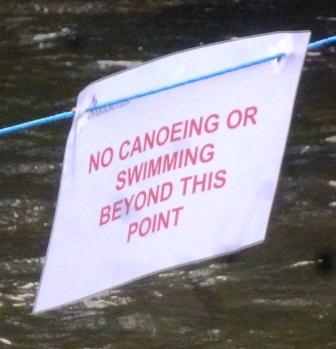
just above the top weir, there is a rope across the water with several signs hung on it ...
Talking to a lady who lives in a house just down the road, she has never known anyone trying to canoe over the weirs, nor try to swim here. I'm wondering if it will be seen as a challenge to those who have a mind to buck authority. Interestingly, the lifebuoy rings are only in place during the day, in case one of the workmen need to be rescued. At night they are stored safely away, so that pranksters don't throw them into the fats flowing water.
And another sign amused me too, one you see everywhere but today I just saw it differently.  Could this possibly be a new Olympic sport?    Lifting very heavy umbrellas?
Here's another comparison of the top weir ... between two days ago when the double drop could be easily seen as well as the great boulders just below the weir. Now that drop is less easy to see and the down flow pattern seems to be changing day by day.
Something else that alters daily is the amount of heavy stone coming in from two fairly local quarries as well as manufactured concrete blocks, what is their part in all this?
Like me ... you will just have to patiently wait and see ... as work progresses.
Meanwhile there is at least one fisherman on the river ... a heron!

Monday, 6 August 2012

FENCE POST GROWTH ...

For over five years now, I've been watching some small, round, self seeded "gardens".
There is a line of them along a track leading out of Craig Waur Forest, and all different.
This one has a tiny two inch larch seedling amongst whinberry and mosses.
In this one, sphagnum moss and whinberry seedlings with small lichens. 
On this next cushions of moss, lichens and a hopeful blackberry seedling.
 This rather sparse one, with moss, a new, tiny silver birch shorter than the grass.
 On this one the grass is dominant, but has been nibbled shorter by something ...
 Here quite a few whinberry seedlings rise taller than the sphagnum & lichens
Another tiny silver birch in a wonderful cushion of different mosses.
And lastly caught in a ray of sunshine in the shade of the big trees ...
A tiny Rowan (Mountain Ash) seedling on a heavily lichened fence post.
It has been fascinating to watch all these mature over the last five years, hardly 
The Chelsea Flower Show, but each fascinating in their individuality.
I look forward to seeing how all of these small round fence tops progress.

Saturday, 4 August 2012

A REFLECTIVE MOOD

Every day when I wake, I wonder if there will be anything interesting to photograph and waffle on about, especially on mornings like today, when the weather forecast for Wales last night was ... well ... dire. Derek our weatherman told us cheerfully about thunderstorms and flash floods, even the risk of hail storms. So I woke listening carefully.
The birds were twittering and tweeting (avian style) and a peek outside ... dry ... great!
I was in a reflective mood today, wondering about whether I would run out of things to "Blog" about in such a relatively small area and worrying if I was becoming too repetitive with some of the subjects I cover in my posts. I was feeling very stiff and yes ... grumpy!
A few hours later once the morning joints had been greased and felt more mobile, we set off up to the moorland in the vague hope of seeing some grouse ... not a sign ... just sheep.
These two had obviously escaped the big gather and retained their thick warm fleeces, no bad thing considering the heavy front, fast heading our way and yes ... we got caught in it, so had to take some time sheltering under the protective canopy of a lovely old beech tree.
We had a good viewpoint over the valley below, the old dismantled reservoir and the newly naked hay fields looking so bleach pale against the lush greenery of other pasture.
Somewhere in the far distance, shrouded by mist was England and roughly as the crow flies (supposedly in a direct line, ha-ha) there was a very busy city hosting The 2012 Olympics. It all seems so far removed from rural life here, where the only races seem to be harvesting against the clock or dosing & inoculating the flock in time to save future problems.
To our left as the rain dripped off the leaves of our beech shelter, the deep head of the valley, from which if one walked far enough one could reach The Brecon Beacons and a valley I love ... The Elan Valley which in a good autumn can look almost as stunning as a Canadian fall with all it's glorious colours. But not on a rather grey day, like today.
The rain eventually passed over and we headed back through knee deep wet rushes and heather to where we'd parked. The daft dog was exploring all the rain fresh scents and rolling around in the soaking heather, a canine version of a car wash! That's when I spotted this fairly unusual sight ... a lovely, shining white heather.
That was it for the rest of the day until I realised we needed to get a few bits of essential shopping and just as we headed towards town, the thunder drum rolled the intro to a real humdinger of a black clouded front heading our way. Diving into the store I watched through the huge windows as the rain came down in absolute torrents, and people in summer dress and sandals almost waded across the car park. Having got the necessary items I joined others under the canopy of the store to watch the clouds cross over as if in an Olympic race themselves, they were moving that fast and we watched and waited for it to pass over, which it did followed by clear skies and sunshine reflected back off the now quite deep pools of water in the parking areas. We headed towards home but took our chance stop off for a short walk to visit a memorial site. The Six Bells Memorial Miner.
On the way to visit the commemorative  statue, I noticed this Magpie Moth caterpillar.
I will dedicate a whole post to this  amazing memorial another day with more details ..
Against the clearing clouds it stood out as a dark almost beseeching silhouette.


But what really caught my eye today was the sun shining just behind the steel constructed 20m statue named "The Guardian." It seemed like a brightly shining, solar halo. An even more intriguing image attracted my attention as we walked around the edges of the small rush edged pond.
As I wrote earlier, I was in a reflective mood today but this made me realise that one never knows at the waking start what will happen during the hours before bedtime.

Friday, 3 August 2012

WEIR BUSTERS.

Remember that opening song line ... "What a difference a day makes. 24 little hours." ?
Well today, almost spot on 24 hours later we returned to see what progress there was on the "Weir Busters." And no they are not using bouncing bombs to demolish them. In fact they are being redesigned, but before the weirs themselves can be tackled, a lot of preparation has to take place, like the removal of trees both sides of the Ebbw River.
Above was the scene yesterday ... and in the next the same as seen today. The tree surgeons, all the way from West Wales ... had been working hard felling unwanted trees.
And in between the two weirs ... on the banks even more heavy weight machinery ...
The digger on the left was creating a ditch and laying in large core pipe to cope with the diverted water once the work on the main project really begins. Meanwhile down river ... just below the lower second weir that is due to be demolished 
A bright yellow "silt net" had been stretched from bank to bank. This will catch the debris created when the lower weir starts to get broken up and the silt & stones will be removed in order not to cause problems further down.
Like lemon yellow dinosaurs they were hungrily devouring the local landscape that only just recently looked so pleasant and summery. Trees disappearing, much of the foliage getting crushed under heavy track, it all seems such a noisy mess at the moment, but as one of the tree surgeons said, the recovery time will be quick and the banks better off for a good thinning out. But ... on the other side of the river to us was an invasive, non native weed, that we really don't need ... 
Himalayan Balsam! Such an attractive flower and much loved by bees, but takes over wherever it grows, which can be to an alarming 3 metres high. A giant annual weed.

It also has very explosive seed heads which project seed several feet around the parent plant. The tree surgeon I spoke to told us that just the vibration of trains and passing cars can set off this explosive response and the seeds will then travel in the air flow created by vehicles, thus spreading it even faster. This also of course means that close to a river, the flowing water carries these seeds at speed, further spreading it's progeny. I will refer to this pretty pest again but if you check out the website "Himalayan Balsam Wales" it will give you lots of information as well as demonstrating through their updated blog, difficulty of trying to eradicate the damn stuff! Though ... there is hope being sourced from the Himalayas, it's native home where they have found something that attacks the plant and will not effect other species ... we shall wait and see. Meanwhile we've a river project to observe over the next few months. Makes a change from hay making and sheep!
The upper weir as seen here, will go through a modification of of its currently smooth surfaces. A more natural "rockscaping" will ensure small pools and leaps for salmon and eels to navigate as they head up the Ebbw. They then have a choice of Fach or Waur at the confluence where the river splits. (Translated that means Little or Large!)
(For more information about this, check out www.environment-agency.gov.uk and read their entry for 23rd Sept 2011.) It mentions that the Afon Ebbw "is recovering from it's industrial past." Local folk tell me that years ago, one could almost tell what was happening further up the valley by the colour of the water, as it changed at different times from yellow to red to brown to black. Scarily they tell me that as kids they often played in the water, in their innocence not realising the dangers that such dead & deathly water could mean to their future health. For those still alive, they are enjoying seeing this influential South Wales Valley coming back to life. Someone I meet regularly along this Ebbw Fach Trail, has been so grateful for the new tarmac path. He had a stroke a few years ago but one handedly manages a motorised scooter. For him and others in a similar state of limited mobility, this smooth track has opened up a whole new, safe way of getting out and about when the sun shines. He also now, has like me, a new interest ...
How will this latest regeneration project turn out?
We shall see ... "As time goes by."

Thursday, 2 August 2012

WEIR & WONDERING.

No folks, the title is not a spelling mistake and I will explain why in a minute.  Remember the saying, you never know what is around the next corner? Well today I dropped my pensioner off at the Doctors and then took the dog for an amble down our new local cycle track, part of The Ebbw Fach Trail. Only just recently carefully tarmacked at great expense and completed, so imagine my surprise at seeing lots of heavy plant machinery!

Works signs everywhere and men in hi-viz jackets ... "What on earth was going on?" A notice re: A demolition site ??? Hey, this cycle track is only a few weeks old and now all the new, shiny black path is covered in mud and obviously suffering from the weight of such machines as these ... 
<<< I was intrigued and asked a local man, who explained.
This part of the Ebbw river has two weirs, this one up river from where I took this photograph >>>
On the opposite bank men & more machines were felling the trees and down river the second weir was about to be dismantled and rebuilt ... (a far from easy job to tackle in these fast flowing waters!)


Not as you may imagine because the structure that has been there for a long while now was in a bad state of repair. 


No ... the reason was to do with fish, salmon to be precise. Apparently these migratory fish have made it as far as Risca, further down the valley but can head upstream no further without a little help ... I shall rephrase that ... after nearly three months of work and at great expense. Is it all worth it for a few fish many will ask especially in these financially turbulent times. Having spoken to local folk who remember this river running from Ebbw Vale in the heyday of the mining and steel working industry, they have vivid memories of this now clear running and healthy water, turning different colours from yellow, to red and at times almost black. No fish could live in it and this now attractive water course seemed to be totally dead. Thanks to the fairly recent efforts of a large band of caring volunteers to do a huge clean up, the Ebbw started to come back to life and this is just another chapter in this rivers' long and often troubled history.
It is actually two rivers joined, The Ebbw Waur flows from Mynydd Lllangynidr and the Ebbw Fach  from Mynydd Llangattwg, joining up together at Aberbeeg to form the river you see here. It then flows down to Usk and The Severn Estuary, from where our future salmon will be swimming their migratory way up and past us. Meanwhile certain safety precautions are needed as both weirs are redesigned to allow salmon to head up the valley
There is another saying "Using a hammer to crack a wall nut."  ^^^ That's one helluva way to knock a fence post in! Lifebuoy rings have to be put in place (haven't seen any of those in past years) and no doubt they will end up being flotsam in the water after young pranksters have thrown them in, but as one of the guys told me, "Rules are rules."
I think this fence post top sums that officialdom up ...
I will be keeping an eye on how thing's progress on this part of the river.

Wednesday, 1 August 2012

AUGUST BEGINS

So ... the first day of August and it's all happening, school holidays, the Olympics etc, etc.
Here cooler temperatures and light drizzle. We take one of our pensioners daily down to the Docs, for treatment of an ulcerated leg. He's in for a while, so we go walkabout.
It's hard to believe that where this modern Surgery now stands, used to be the site where the local Webbs Brewery once provided beer for all the local mining community from 1838 - 1969. Some local  buildings still retain the engraved stonework of 1898 & 1899. The old police station is now a well looked after private house.
The road leads behind the long row of terraced houses.
It was drizzling lightly as we went exploring and one of the wonderful things about wet weather is the way it brings the colour of the foliage into glistening contrast. >>>
Even something as common as young blackberry leaves can shine out like jewels in the thick, rambling overgrown hedgerow. Underneath these leaves, St Johns Wort was in full golden flower. A medicinal herb,  around here it grows in profusion more like an uneeded weed, as does another, yellow flowered, medicinal plant ... Evening Primrose, though they were originally introduced from North America & Chile, they are now mostly very variant hybrids. (Francis Rose)
The above are a smaller variety, managing to compete with the very invasive, thick goose-grass and rambling brambles, but they provide sunshine cheer on a grey day.
As the skies darkened and more rain threatened
<<< this delicately flowered plant glowed moon-like out of the dark recesses of a deeply shadowed wall. This plant twines and climbs, the blooms not lasting long but while they do, their white trumpet flowers just shine with a wonderfully pure white.
The colours in the growth along the side of the road were really highlighted today under the grey, rain heavy skies.. Everything smelled fresh after the light drizzle and the dog was clearly enjoying exploring the lower level scents. Most probably "blog spots" posted by other dogs.  At a higher level, there was the pleasure of the edible ... wild raspberries in profusion ... delicious, rain washed, fresh fruit!
Walking along the backs of these terraced houses there was also the pleasure of seeing cultivated flowers in sharp contrast to the rambling, climbing bank on the other side of the road. One plant at least seemed to want to take a peak at what life was like "on the wild side of life." This lovely red nasturtium >>>
had squeezed it's way through a gap between stone wall and wooden fence. All parts of this cultivated plant are edible, leaves and flowers in salads (as seen on many posh chef programmes) but pickle the seeds in vinegar and you can have your own "poor man's capers" to use when making fish dishes. Try it, it's worth it and ... they are easy to pick!
And another plant glistening with the light rain was this variegated ivy, rambling over an old stone wall. It almost reminds me of some painter just playing with splashes of colour.